《Advances in Engineering》published:

Recently, Advances in Engineering, a well‑known international engineering and technology news platform, has published a feature research highlight reporting key progress made by Professor Chen Tong’s research group from our university in the field of two‑dimensional ferroelectric‑material‑based gas sensors. Centered on the group’s research paper published in Langmuir (DOI: 10.1021/acs.langmuir.5c04115), the report notes that this work “offers brand‑new design concepts for gate‑tunable room‑temperature gas sensors”.
Each week, Advances in Engineering selects approximately 30 highly innovative, application‑oriented and globally‑noticed research outputs from top‑tier global engineering journals for featured coverage, aiming to rapidly deliver cutting‑edge engineering‑technology updates to engineers and researchers worldwide. This inclusion signifies international peer recognition of the study’s engineering application value and academic innovation.
This research was led by Professor Chen Tong as the corresponding author, with Peng Tang, a 2023‑admitted master’s student, as the first author. Our university serves as the primary affiliation. The study systematically reveals the gate‑voltage‑tunable gas‑selective sensing mechanism in bilayer ferroelectric In₂Se₃ and realizes electrically reconfigurable detection of three pollutant gases: NO, NO₂ and NH₃. It lays a theoretical foundation for developing next‑generation intelligent gas sensors.
Article Information
Title: Gate‑Tunable Bilayer In₂Se₃‑Based Room‑Temperature Gas Sensor with Ultrahigh Sensitivity and Selectivity for NO, NO₂ and NH₃
Corresponding Author: Tong Chen*
First Author: Peng Tang
Affiliation: School of Energy and Mechanical Engineering / Computational Center for Energy Materials, Jiangxi University of Science and Technology
Research Background
Ferroelectric bilayers attract considerable attention because their out‑of‑plane polarization can directly modify the surface electronic environment. Unlike monolayers, bilayer systems incorporate complex factors including stacking modes, screening effects, interfacial charge and spontaneous‑polarization coupling, which can produce both adsorption asymmetry and transport asymmetry simultaneously. Nevertheless, prior studies on In₂Se₃ gas sensing mainly focused on monolayers, while bilayer systems remained insufficiently explored. This research aims to fill this research gap and illustrate how stacking stability, interfacial charge redistribution, adsorption‑site preference and gate‑controlled transport collectively form a coherent sensing model for NO, NO₂ and NH₃.
Key Findings
Finding 1: Stable Stacking Configuration and Interlayer Charge Reconstruction
Regarding stable stacking configurations and interlayer charge sorting, six stacking arrangements with distinct polarization orientations and lateral registries were examined. The A2 configuration was identified as the most‑stable stacking geometry for bilayer In₂Se₃. Although van‑der‑Waals interlayer coupling is weak within this configuration, the interface is not electronically inert due to screening effects at homopolar interfaces. This indicates that pre‑organization of internal charge within the bilayer completes even before molecular adsorption occurs, establishing an asymmetric electronic environment for subsequent gas‑sensing responses.
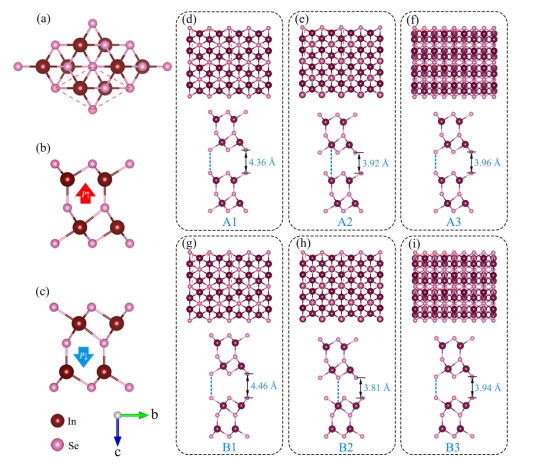
Figure 1. (a) Top view of a 2 × 2 supercell of In₂Se₃ with molecular adsorption sites. (b, c) Side views of P↑ and P↓ states of In₂Se₃. (d‑i) Bilayer In₂Se₃ structures with different stacking configurations.
Finding 2: Distinct Interlayer Adsorption Behaviours
Marked behavioural differences are observed for the three gases at interlayer adsorption sites. At interlayer and bottom sites, NH₃ forms covalent In‑N bonds with indium atoms, triggers lattice distortion and exhibits chemisorption with relatively high adsorption energies. By contrast, NO and NO₂ retain physisorption in their stable configurations; nonetheless their adsorption intensities are strongly site‑dependent. Adsorption is generally stronger on the bottom layer than on the top layer, owing to more effective coupling between molecular dipoles and ferroelectric polarization on the bottom layer.
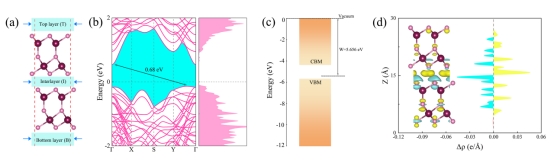
Figure 2. (a) Side view of A2‑stacked bilayer In₂Se₃ with labelled gas‑adsorption sites. (b) Band structure and DOS, and (c) band alignments of bilayer In₂Se₃. (d) DCD and plane‑averaged charge‑density difference of bilayer In₂Se₃.
Finding 3: Recovery Time and Reusability
For recovery‑time performance and reusability, NO and NO₂ adsorbed on the bottom layer show extremely fast recovery at room temperature. Even for NH₃ chemisorbed on the bottom layer, the room‑temperature recovery time is merely 27.9 s, demonstrating favourable room‑temperature reusability of the device. Moderate heating drastically shortens NH₃ recovery time: it drops to the millisecond range at 400 K and further down to tens of microseconds at 500 K, which further validates its practical application potential.
Finding 4: Gate‑Voltage‑Tunable Selectivity
As the core breakthrough, transport calculations reveal that bilayer devices deliver drastically different gas‑response profiles under varying gate voltages. At zero gate bias, the sensitivities toward NO₂ and NH₃ reach 163 % and 108 % respectively, whereas NO yields a weak response. When gate voltage rises to 2 V, NO sensitivity jumps to 101 %, a 2.6‑fold enhancement compared with zero‑gate‑bias performance. At 3 V gate voltage, selectivity shifts: NO₂ dominates with 86 % sensitivity, while the values for NO and NH₃ decrease to 26 % and 6 % respectively. The results confirm that gas selectivity can be tuned by gate‑voltage modulation, delivering innovative design strategies for room‑temperature reconfigurable gas sensors.
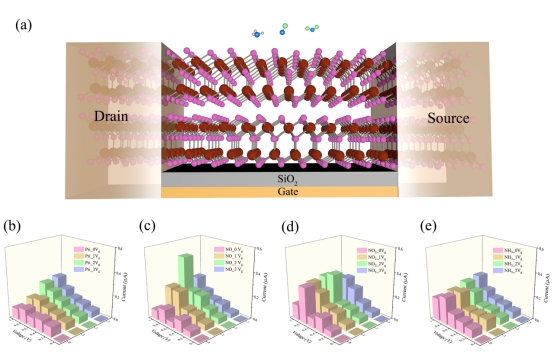
Figure 3. Schematic diagram of a FET‑type gas sensor based on bilayer In₂Se₃. (b‑e) I‑V curves of bilayer‑In₂Se₃‑based gas sensors for detecting NO, NO₂ and NH₃ under different gate voltages.
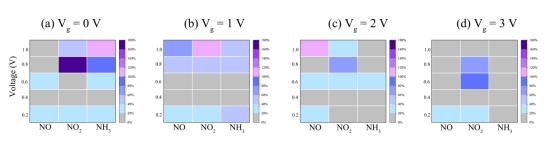
Figure 4. Sensitivity variation patterns for NO‑, NO₂‑ and NH₃‑adsorbed systems under different gate voltages (Vg), plotted against bias voltage (Vb).
Related Link:
https://advanceseng.com/gate-controlled-gas-sensing-in-bilayer-ferroelectric-In2Se3/